 Add to Chrome
 Add to Firefox
 Add to Edge
PRISM: A Multi-Dimensional Benchmark for Evaluating LLM Peer Reviewers
May 27, 2026
The rapid growth in submissions to machine learning venues has strained the scientific peer-review system and intensified interest in LLM-based automated peer reviewers. However, how good these systems are actually, especially compared to human reviewers at catching scientific gaps, remains poorly understood. In this work, we introduce PRISM (Peer Review Intelligence via Structured Multi-dimensional assessment), a benchmarking framework that evaluates review quality across four dimensions: Depth of Analysis, Novelty Assessment,Flaw Identification & Major Issues Prioritization, and Multi-dimensional Constructiveness. Unlike most existing evaluations based on surface-level metrics like ROUGE and BLEU, or unconstrained LLM-as-a-judge prompting that conflates fluency with rigor, PRISM grounds each dimension in argument mining, retrieval-augmented verification, and consensus-based scoring. We apply PRISM to benchmark five leading automated reviewer systems and human reviewers on a stratified corpus of reviews from ICLR, ICML, and NeurIPS. The results reveal that LLMs can match or beat human reviewers on individual dimensions: comparable depth of analysis, stronger novelty verification, and highly accurate critique prioritization. However, no single system consistently matches the balanced performance of the human baseline across all dimensions at once. Each exhibits a distinct specialization profile with characteristic blind spots -- failure modes that aggregate metrics miss entirely. The implication is that LLM reviewers are best understood as targeted supplements to human review, effective within specific dimensions, but unreliable as standalone replacements. Our demo and key results can be found at https://khanhthanhdev.github.io/prism-page/.

Pop-Up Distractions Reveal Bag-of-Events Behavior in Video Large Language Models
May 26, 2026A key capability for video understanding is reliably linking subjects to events across time, yet whether Video Large Language Models (VideoLLMs) actually achieve this remains unclear. In this work, we introduce DistractionBench to evaluate whether VideoLLMs can robustly link subjects and events in the presence of unrelated video segments. Through controlled interventions, such as inserting short advertisement clips into longer videos, we show that VideoLLMs frequently hallucinate interactions between entities from different segments, incorrectly attributing actions from injected advertisements to subjects in the main video. We characterize this systematic hallucination as bag-of-events (BoE) behavior, where models process videos as collections of events rather than temporally structured sequences. Evaluating 11 popular VideoLLMs, we find that all models exhibit substantial BoE behavior. Our findings suggest that VideoLLMs lack reliable mechanisms for temporal grounding and motivate the development of models with more robust subject-event association.
TokenRatio: Principled Token-Level Preference Optimization via Ratio Matching
May 14, 2026Direct Preference Optimization (DPO) is a widely used RL-free method for aligning language models from pairwise preferences, but it models preferences over full sequences even though generation is driven by per-token decisions. Existing token-level extensions typically decompose a sequence-level Bradley-Terry objective across timesteps, leaving per-prefix (state-wise) optimality implicit. We study how to recover token-level preference optimality using only standard sequence-level pairwise comparisons. We introduce Token-level Bregman Preference Optimization (TBPO), which posits a token-level Bradley-Terry preference model over next-token actions conditioned on the prefix, and derive a Bregman-divergence density-ratio matching objective that generalizes the logistic/DPO loss while preserving the optimal policy induced by the token-level model and maintaining DPO-like simplicity. We introduce two instantiations: TBPO-Q, which explicitly learns a lightweight state baseline, and TBPO-A, which removes the baseline through advantage normalization. Across instruction following, helpfulness/harmlessness, and summarization benchmarks, TBPO improves alignment quality and training stability and increases output diversity relative to strong sequence-level and token-level baselines.
Decoding the Critique Mechanism in Large Reasoning Models
Mar 17, 2026Large Reasoning Models (LRMs) exhibit backtracking and self-verification mechanisms that enable them to revise intermediate steps and reach correct solutions, yielding strong performance on complex logical benchmarks. We hypothesize that such behaviors are beneficial only when the model has sufficiently strong "critique" ability to detect its own mistakes. This work systematically investigates how current LRMs recover from errors by inserting arithmetic mistakes in their intermediate reasoning steps. Notably, we discover a peculiar yet important phenomenon: despite the error propagating through the chain-of-thought (CoT), resulting in an incorrect intermediate conclusion, the model still reaches the correct final answer. This recovery implies that the model must possess an internal mechanism to detect errors and trigger self-correction, which we refer to as the hidden critique ability. Building on feature space analysis, we identify a highly interpretable critique vector representing this behavior. Extensive experiments across multiple model scales and families demonstrate that steering latent representations with this vector improves the model's error detection capability and enhances the performance of test-time scaling at no extra training cost. Our findings provide a valuable understanding of LRMs' critique behavior, suggesting a promising direction to control and improve their self-verification mechanism. Our code is available at https://github.com/mail-research/lrm-critique-vectors.
How Many Tokens Do 3D Point Cloud Transformer Architectures Really Need?
Nov 07, 2025Recent advances in 3D point cloud transformers have led to state-of-the-art results in tasks such as semantic segmentation and reconstruction. However, these models typically rely on dense token representations, incurring high computational and memory costs during training and inference. In this work, we present the finding that tokens are remarkably redundant, leading to substantial inefficiency. We introduce gitmerge3D, a globally informed graph token merging method that can reduce the token count by up to 90-95% while maintaining competitive performance. This finding challenges the prevailing assumption that more tokens inherently yield better performance and highlights that many current models are over-tokenized and under-optimized for scalability. We validate our method across multiple 3D vision tasks and show consistent improvements in computational efficiency. This work is the first to assess redundancy in large-scale 3D transformer models, providing insights into the development of more efficient 3D foundation architectures. Our code and checkpoints are publicly available at https://gitmerge3d.github.io
The Reasoning Boundary Paradox: How Reinforcement Learning Constrains Language Models
Oct 02, 2025Reinforcement Learning with Verifiable Rewards (RLVR) has emerged as a key method for improving Large Language Models' reasoning capabilities, yet recent evidence suggests it may paradoxically shrink the reasoning boundary rather than expand it. This paper investigates the shrinkage issue of RLVR by analyzing its learning dynamics and reveals two critical phenomena that explain this failure. First, we expose negative interference in RLVR, where learning to solve certain training problems actively reduces the likelihood of correct solutions for others, leading to the decline of Pass@$k$ performance, or the probability of generating a correct solution within $k$ attempts. Second, we uncover the winner-take-all phenomenon: RLVR disproportionately reinforces problems with high likelihood, correct solutions, under the base model, while suppressing other initially low-likelihood ones. Through extensive theoretical and empirical analysis on multiple mathematical reasoning benchmarks, we show that this effect arises from the inherent on-policy sampling in standard RL objectives, causing the model to converge toward narrow solution strategies. Based on these insights, we propose a simple yet effective data curation algorithm that focuses RLVR learning on low-likelihood problems, achieving notable improvement in Pass@$k$ performance. Our code is available at https://github.com/mail-research/SELF-llm-interference.
Mitigating Reward Over-optimization in Direct Alignment Algorithms with Importance Sampling
Jun 11, 2025Direct Alignment Algorithms (DAAs) such as Direct Preference Optimization (DPO) have emerged as alternatives to the standard Reinforcement Learning from Human Feedback (RLHF) for aligning large language models (LLMs) with human values. However, these methods are more susceptible to over-optimization, in which the model drifts away from the reference policy, leading to degraded performance as training progresses. This paper proposes a novel importance-sampling approach to mitigate the over-optimization problem of offline DAAs. This approach, called (IS-DAAs), multiplies the DAA objective with an importance ratio that accounts for the reference policy distribution. IS-DAAs additionally avoid the high variance issue associated with importance sampling by clipping the importance ratio to a maximum value. Our extensive experiments demonstrate that IS-DAAs can effectively mitigate over-optimization, especially under low regularization strength, and achieve better performance than other methods designed to address this problem. Our implementations are provided publicly at this link.
Are you SURE? Enhancing Multimodal Pretraining with Missing Modalities through Uncertainty Estimation
Apr 18, 2025Multimodal learning has demonstrated incredible successes by integrating diverse data sources, yet it often relies on the availability of all modalities - an assumption that rarely holds in real-world applications. Pretrained multimodal models, while effective, struggle when confronted with small-scale and incomplete datasets (i.e., missing modalities), limiting their practical applicability. Previous studies on reconstructing missing modalities have overlooked the reconstruction's potential unreliability, which could compromise the quality of the final outputs. We present SURE (Scalable Uncertainty and Reconstruction Estimation), a novel framework that extends the capabilities of pretrained multimodal models by introducing latent space reconstruction and uncertainty estimation for both reconstructed modalities and downstream tasks. Our method is architecture-agnostic, reconstructs missing modalities, and delivers reliable uncertainty estimates, improving both interpretability and performance. SURE introduces a unique Pearson Correlation-based loss and applies statistical error propagation in deep networks for the first time, allowing precise quantification of uncertainties from missing data and model predictions. Extensive experiments across tasks such as sentiment analysis, genre classification, and action recognition show that SURE consistently achieves state-of-the-art performance, ensuring robust predictions even in the presence of incomplete data.
Unveiling Concept Attribution in Diffusion Models
Dec 03, 2024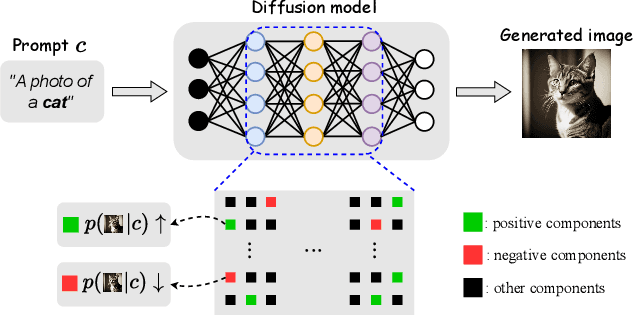
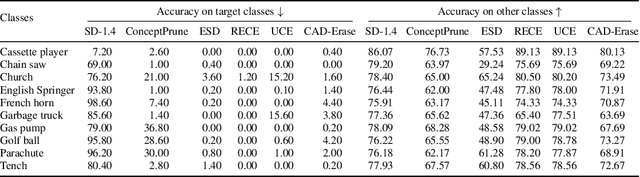
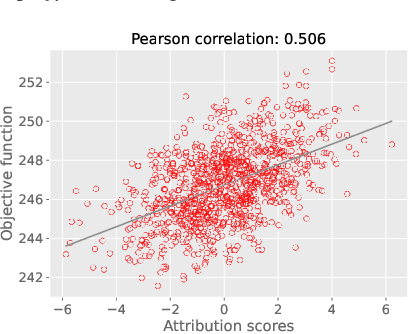
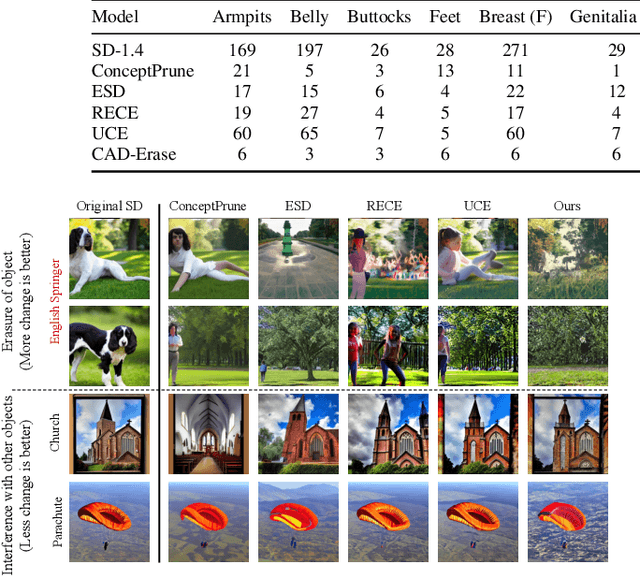
Diffusion models have shown remarkable abilities in generating realistic and high-quality images from text prompts. However, a trained model remains black-box; little do we know about the role of its components in exhibiting a concept such as objects or styles. Recent works employ causal tracing to localize layers storing knowledge in generative models without showing how those layers contribute to the target concept. In this work, we approach the model interpretability problem from a more general perspective and pose a question: \textit{``How do model components work jointly to demonstrate knowledge?''}. We adapt component attribution to decompose diffusion models, unveiling how a component contributes to a concept. Our framework allows effective model editing, in particular, we can erase a concept from diffusion models by removing positive components while remaining knowledge of other concepts. Surprisingly, we also show there exist components that contribute negatively to a concept, which has not been discovered in the knowledge localization approach. Experimental results confirm the role of positive and negative components pinpointed by our framework, depicting a complete view of interpreting generative models. Our code is available at \url{https://github.com/mail-research/CAD-attribution4diffusion}
Flatness-aware Sequential Learning Generates Resilient Backdoors
Jul 20, 2024


Recently, backdoor attacks have become an emerging threat to the security of machine learning models. From the adversary's perspective, the implanted backdoors should be resistant to defensive algorithms, but some recently proposed fine-tuning defenses can remove these backdoors with notable efficacy. This is mainly due to the catastrophic forgetting (CF) property of deep neural networks. This paper counters CF of backdoors by leveraging continual learning (CL) techniques. We begin by investigating the connectivity between a backdoored and fine-tuned model in the loss landscape. Our analysis confirms that fine-tuning defenses, especially the more advanced ones, can easily push a poisoned model out of the backdoor regions, making it forget all about the backdoors. Based on this finding, we re-formulate backdoor training through the lens of CL and propose a novel framework, named Sequential Backdoor Learning (SBL), that can generate resilient backdoors. This framework separates the backdoor poisoning process into two tasks: the first task learns a backdoored model, while the second task, based on the CL principles, moves it to a backdoored region resistant to fine-tuning. We additionally propose to seek flatter backdoor regions via a sharpness-aware minimizer in the framework, further strengthening the durability of the implanted backdoor. Finally, we demonstrate the effectiveness of our method through extensive empirical experiments on several benchmark datasets in the backdoor domain. The source code is available at https://github.com/mail-research/SBL-resilient-backdoors